The photo
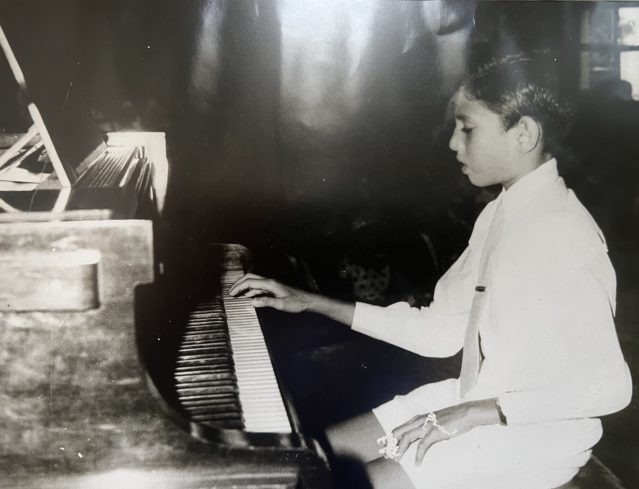
In this photograph taken in June 1965, the pianist is a fourteen-year-old. The venue is Ladies College hall, located in Colombo’s plushest suburb, Cinnamon Gardens, a cinnamon estate in olden days. After colonial spice policies suppressed cinnamon production, the owners of that same land, in the early 1800s, couldn’t find a buyer at two cents an acre. Then, in the mid 1800s, the British built a turf club there, which attracted rich families to the area, and the real estate value has been climbing ever since.
The hall of Ladies College, arguably Colombo’s then premier venue for performing arts, was sought after for concerts by overseas musicians and also locals who had made a name for themselves overseas. I wasn’t one of those illustrious groups, then or since. I was one of a bunch of youngsters, each of whom had come first the previous year in examinations conducted by Trinity College of Music, London, who sent British examiners to Colombo every year. I had scored the top mark in Junior grade piano. In the photo I’m about to play the rush of chords that bring to an end a piano arrangement of Pizzicato Polka by Johann Strauss. I’m dressed in the standard colour of children’s attire for special occasions. I remember my anxiety on stage awaiting my turn. I remember the palpable relief when I sat down after hammering the last chord. I thought I’d played without a single mistake, although my brother said he detected a few. No matter. I won two prizes: one for my achievement, a ten-rupee voucher, which I used to buy some music books, and the London Exhibition prize, a seventy-rupee voucher. I never found out what the latter prize meant, why I had been awarded it, or what happened to it after it disappeared into my father’s pocket.
It is what the photo does not reveal that is most vivid in my memory. Early in 1965, a piano tuner declared that our piano had dry rot. Without expensive treatment it was destined to end up in a pile of dust in the not-too-distant future. He offered to buy it, my father negotiated a price, and a few days later a van took it away.
I asked my father when I could expect a new piano. I didn’t add, because he knew already, I had the Grade 5 intermediate piano examination coming up in a few months, and, of course, the concert in June.
‘When I can afford it,’ he replied, tersely. Which meant, more than anything else, he didn’t want me badgering him about it. And I waited expectantly, in silence because I was afraid of him.
My Grandma’s piano was out of bounds. A year earlier, my father had fallen out with all my mother’s people, and we, his children, were barred from having any contact with them. We were not even allowed to attend my Grandpa’s funeral.
There was a piano in the school chapel, and I’d seen a covered grand piano backstage in the school hall, but on inquiring was told under no circumstances would they be made available for students.
Desperation began to set in. After school, on the longish walk home from the bus stop I heard the sound of a piano wafting out of a house. Before my natural shyness had a chance to assert itself, I marched up to the front door and knocked. The lady who answered was sympathetic to my dilemma and granted me a practice session the following afternoon. I had a few more sessions on that piano until the April holidays when the household locked up and went away.
During the holidays I went to Colombo’s two piano shops and asked to practice on one of their pianos. The manager of one shop knew my father and was happy to help me. One morning I spent three hours practicing on a piano displayed in the shop window, oblivious to passers-by, even those who stopped to gawk.
When I began to panic two weeks before my examination, my father rented a piano for one month. Every day after school, I ran from the bus stop to the piano stool and six hours later flopped into bed exhausted. I did the exam, played in the concert three weeks later, then gave up piano lessons and with it all aspirations for a career in music.
Years later, when I asked my father why he didn’t buy another piano, he replied that he couldn’t afford it.
By this time I was no longer intimidated by him, and I spoke my mind. ‘No, you could afford a second-hand piano. You witnessed my struggle, my anxiety, my desperation, and did nothing until I began to panic.’ I then got off my chest something that had rankled me for years. ‘To make matters worse, I couldn’t even practice on Grandma’s piano because holding onto your anger was so important, you didn’t care how much your children suffered because of it. Sometimes I wonder what sort of a father you really were.’
Unafraid, I watched his mouth twist in rage. But he had no outlet for his anger anymore, and his face soon returned to normal.
A week later, he approached me. ‘Son, I didn’t want you becoming too serious about music because I believed it was a career for women, not men. It isn’t the only thing about which I was wrong, and which I bitterly regret.’ I didn’t need to ask him what those things were. I could list them now.
I returned seriously to the piano when I could afford one, a few years after I migrated to Australia. Over fifty years later, I still practice almost daily, striving to improve my technique in order to play music I love.


