China 2025 – April 17
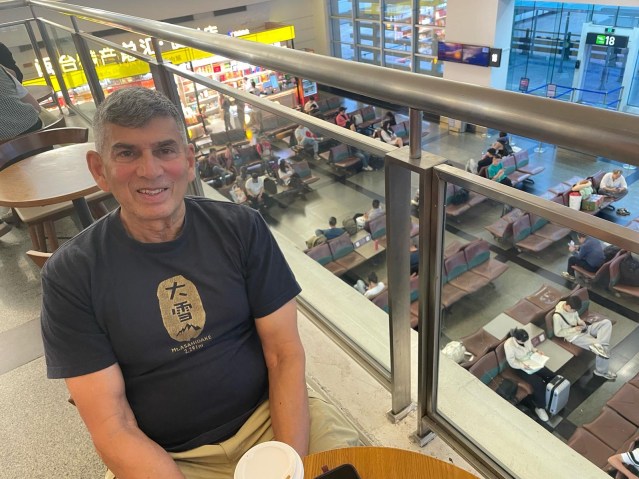
Good morning Xiamen. It’s early, very early. Heeding the stern advice of yesterday’s bus driver, we are catching the 4:40am bus to the airport for our 7:15am flight to Changsha. I feel fresh even though I couldn’t have slept for more than three hours. The Goldilocks weather is neither hot nor cold. We reach the airport in twenty minutes and go looking for our flight’s check-in counter to get our boarding passes. Finding it takes a few minutes. A few more minutes to have our cabin luggage and ourselves scanned, and we are in the domestic departure area with a longish wait. We wander around looking for coffee and maybe a snack. We settle for Starbucks where we sit while the minutes crawl by.
The flight to Changsha is short, an hour and a half. I love my window seat, in which I am able to lose myself in the vistas below. I see myriad clusters of dwellings that look small and humble from my great height. Among them are mosaics of what look like market garden plots, but may be larger-scale cultivations. Beside me sits a young man with his father on the other side. He looks sweet because of his youth. I can make out features that might lose their sweetness when maturity strikes. He’d probably end up looking just like his father. Not that it matters. They both look goodly sorts.
We reach Changsha before nine and decide to take the earliest possible high-speed train to Zhangjiajie. This entails a step into the unknown to cancel our 12:30pm booking and purchase tickets for an earlier train. The taxi driver doesn’t help by casting doubt on the railway station (Changsha West) to which we ask him to take us. He insists all the bullet trains stop at another station (Changsha South). We prefer to rely on trip.com where we booked our tickets and insist on being dropped off at Changsha West.
We find the ticket office and join the queue. We would never have cancelled our booking had neither of us been able to speak Chinese. We see kiosks for purchasing tickets, but we have already learnt from a YouTube video that only a local possessing an identity card can purchase a ticket from them. We see a few foreigners give up in frustration. We occupy the ticket window for ages, and the restlessness of people behind us becomes vocal, but Bock succeeds and we hurry away with fresh tickets. I don’t know whether I’ll be refunded the cost of our original booking . I won’t fret for long if I am not. I move on from such things easily enough. A week later I am refunded, minus a large cancellation fee.
We take a few minutes to locate the platform because parts of the station are a construction site. We eventually locate a narrow passage that opens out onto a concourse at the far end of which is the entry to our platform. No rush, we have plenty of time. I am already craving some decent food, a glass of red wine or something stronger, and to be knocked out for solid for six hours tonight at least. Our adventure has begun, but our holiday proper still awaits almost four hundred kilometres away. The bullet train can cover most of them in two short hours. Time seems to pass more quickly in high-speed trains. I experienced this in Japan.
The train is hurtling through the middle of a vast expanse of paddy fields studded with little clusters of dwellings, some double storeyed, some dilapidated, some, if not all, inhabited because there is washing hanging out to dry. I don’t see people about. I’d have expected to: paddy fields need tending. The fields are wet, some waterlogged, and still the area looks arid, reminding me of Sri Lanka’s dry zone. We leave the paddy fields and enter forested, ascending terrain. It seems the mountains that occupied the horizon are now above us. I experience the same excitement I recall in the upcountry train on my first sighting of Sri Lanka’s marvellous hill country.
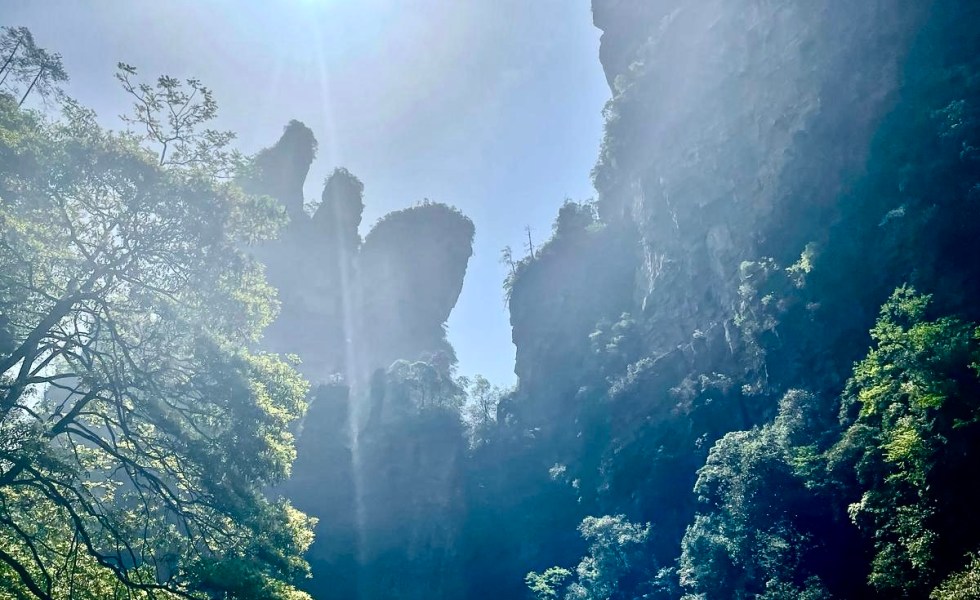
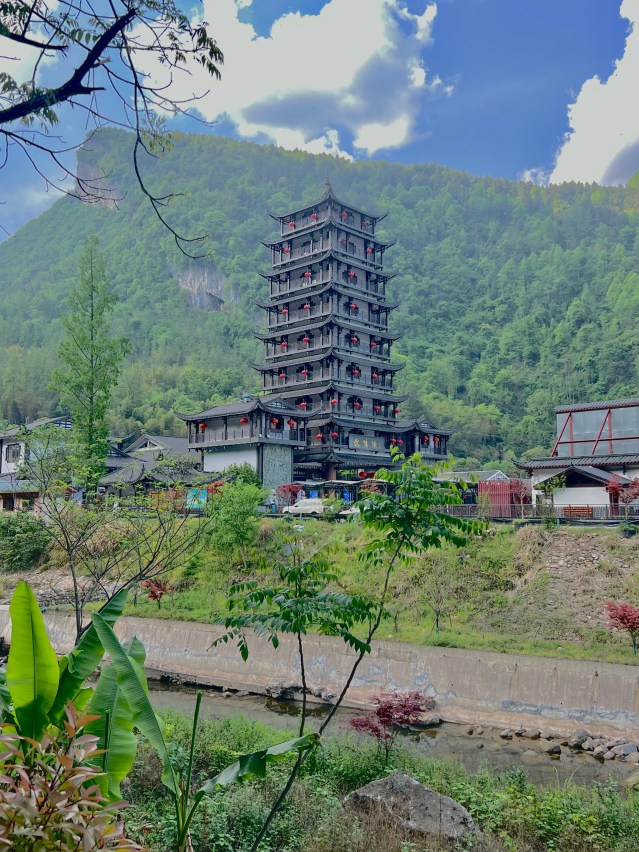
We exit Zhangjiajie station and, after negotiation with a few drivers – some of them outright extortionists, take a taxi to Wulingyuan where we will spend one night before embedding ourselves in the Zhangjiajie national park for the next three days. As the taxi approaches Wulingyuan, the region’s iconic topography becomes evident. Steep, craggy mountains surround us.
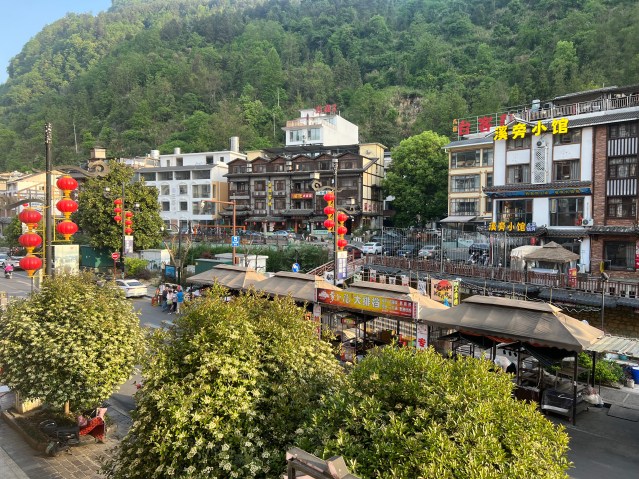
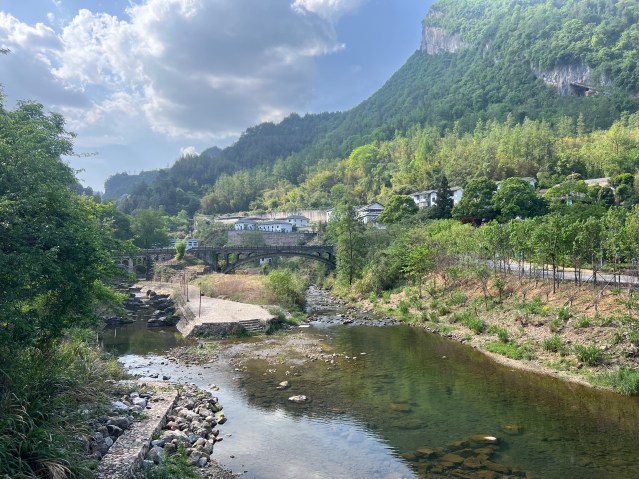
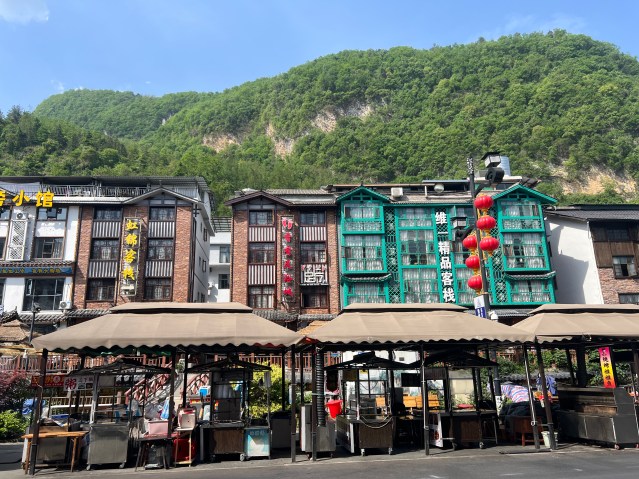
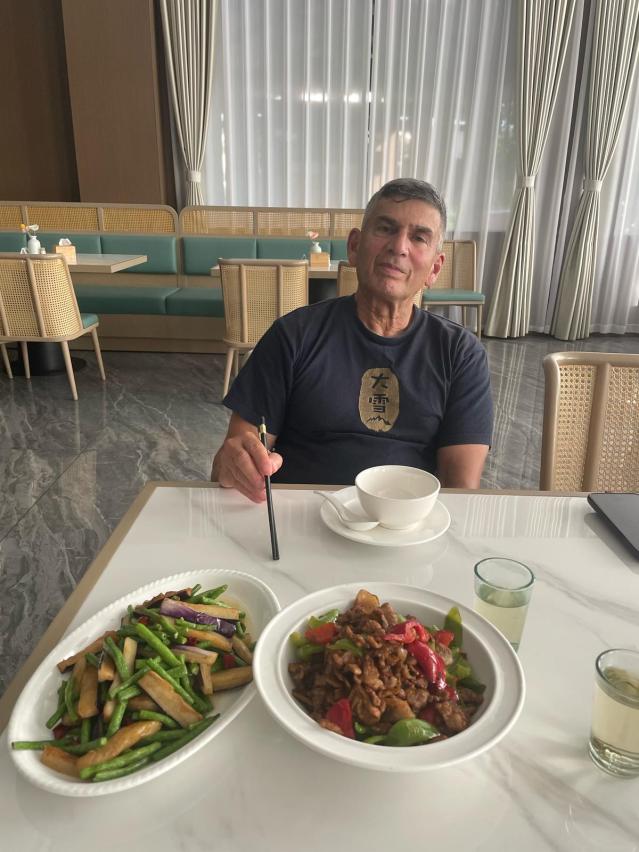
We check into our hotel, park our baggage and head off to check out the town. Wulingyuan is like a resort town, with hotels and restaurants, and a street-food strip that starts up every evening. It is located beside the east gate of the national park, and many people stay there while visiting the park. We see a footpath in the forest beside a creek on the outskirts, and decide to find out where it takes us. Two kilometres later we arrive at the east gate of the national park. By now we are hungry. We decide to walk to a restaurant recommended by a YouTube food blogger. The walk is much longer than expected with a fair number of wrong turns, despite having a map to follow. Eventually we find it in the grounds of a large hotel, of which it is a part (the map never mentions this important piece of information, and we assume the restaurant has a street frontage). It is early, around 5pm, and the large restaurant is almost empty. The waitress tells us that tour groups will pour in from the park later. By 7pm there will be no room to move, she adds.
We order 3 dishes unique to the region. One contains slices of cured pork, a speciality in these parts, another has beef and smashed green peppers, and the third, which we encounter in other places too, is made up of eggplant battens and snake beans. All are delicious, full of flavour. The pork is very fatty and not edible after we pick off all the lean meat. We pack up the leftovers for another meal later on.
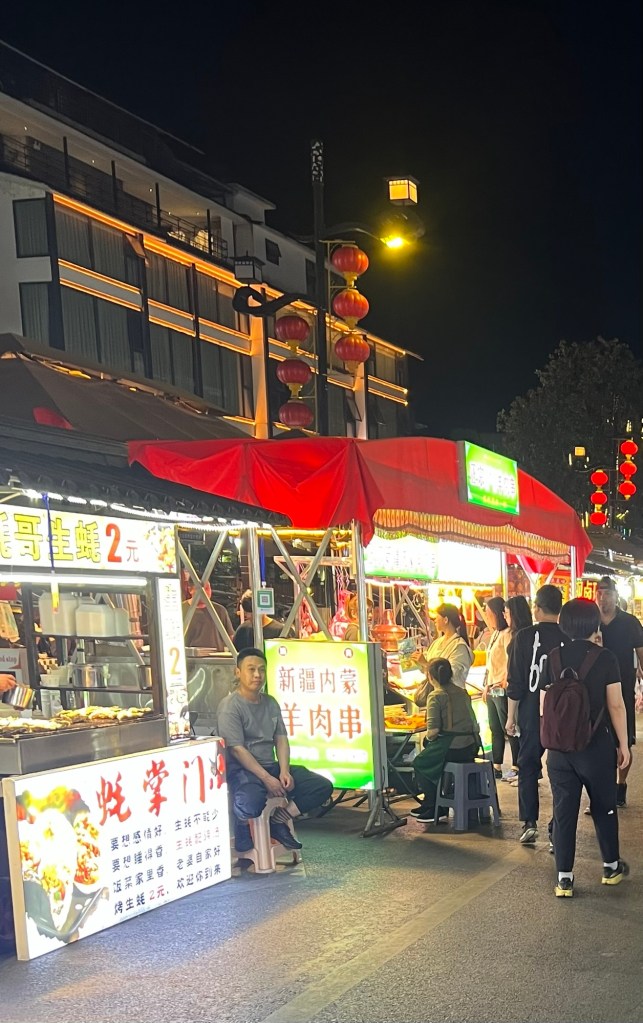
When we return to our hotel, the street-food stalls outside are open. Too full for even a morsel, we have only curiosity to satisfy. Many stalls are selling skewers of meat and seafood, which are cooked to order. Another stall cooks fried rice and noodles. One stall’s entire fare is fried chicken. A couple are selling alcoholic fruit drinks.
We return to our hotel to pack our backpacks with enough clothes and toiletries for the two nights we will be spending in Yolo, a hotel inside the national park. We pack umbrellas and raincoats too as rain is forecast. We don’t forget chargers for our mobile phones and smart watches, and power banks to keep our phones running all day.


 Gerry Roberts