Nihal – a poor man
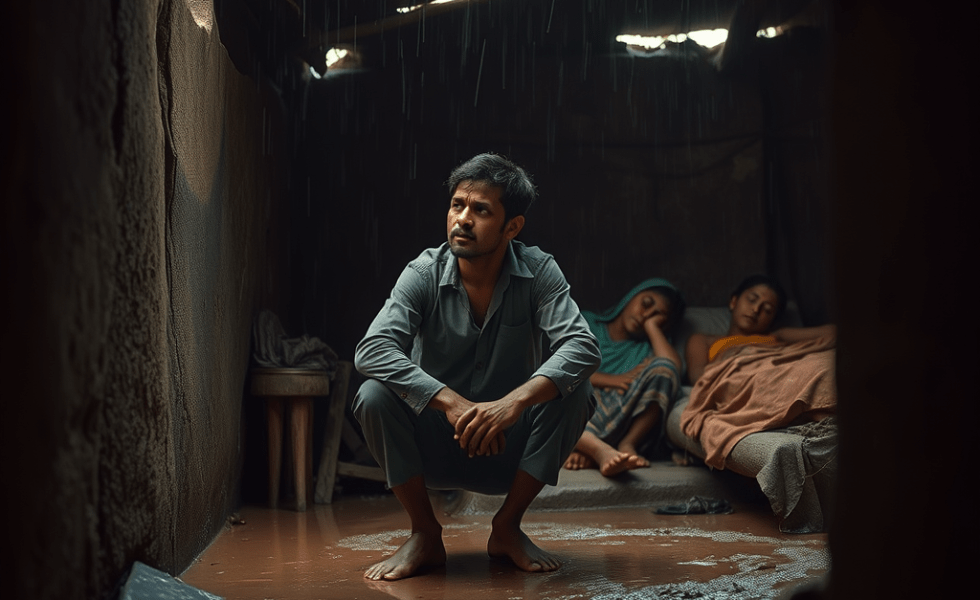
Nihal knows that ruthless rain is finding every little hole, crack and crevice in the roof and walls of his tiny hut on the bank of the smelly canal that marks the city’s southern boundary. On his haunches in the middle of the single room hut, he regards his wife and four children, bunched up in a dry corner, an entanglement of heads, torsos, arms and legs, all of them peacefully asleep. A sturdy lot, especially the children for having survived infancy, unlike four others who didn’t reach their first birthdays. Sad but not unexpected. Infant funerals are a common occurrence among the canal bank community.
He turns his attention to where rainwater is seeping in. It isn’t difficult to spot. He can tell from places where the dirt floor has turned to mud. He isn’t worried. He has learned to dispense with worrying. It serves no purpose. Whatever happens, like his entire life when it comes down to it, is business as usual. Year after year, in the weeks leading up to the monsoon, he and his neighbours set about waterproofing their huts. And year after year, the monsoon’s squally rain tests the quality of their work. It will take more than a few episodes to seal every leak. Until a particularly fiendish downpour creates new waterways through the flimsy structures. Still squatted, he dozes off, a skill he’d developed a few years ago, about the time when as a new father he became acutely aware of responsibilities that prioritised his family’s needs above his own.
He wakes up with a start. Silence. The wind has died down, the rain has stopped. He’d better get cracking and attend to the leaks. His eldest son will get up and want to help him. He will allow him, but only for a little while. Not his wife, even though she’d be up soon, her morning taken up making tea and rotis and getting three kids ready for school. Fortunately their tiny hearth is dry, and so far they have managed to keep rainwater away from their meagre dry goods: an ever-dwindling supply of rice, flour, lentils, salt, and sugar.
While rearranging the Cadjan on the roof of his hut, Nihal is aware of the full day ahead. He has to be on the main road by 6am when the lorry arrives to pick him and others up to take them to the roadwork site. He is never sure of getting work. Sometimes the lorry does not come, sometimes it comes early, sometimes fewer people than those assembled are required and he misses out.
Today he misses out. The street corner is empty, which means the lorry was early. He accepts the setback and ponders his options. Money, as always, is desperately short. He raises his eyes to the sky. Dark, angry clouds presage more rain. That rules out begging door-to-door with his youngest daughter, whose smiling, wide-eyed innocence has a better chance than him of arousing the sort of compassion that plunges hands into pockets and purses. He walks to the nearest railway station, a few miles away. Maybe the best locations, normally procured by beggar syndicates, will not be occupied because of the weather. Maybe even the enforcers who keep those locations clear for their beggars will also stay away. He’ll take the chance.
Nihal doesn’t qualify to be hired by a syndicate because he isn’t disabled in any obvious way. The syndicate beggars with whom he’s chatted are generally happy with their lot. They consider themselves employees, dropped off in the morning at their designated locations and picked up at dusk. They are provided with basic needs like food, water and somewhere to sleep. Of course, they have to fulfil daily quotas. That requires them to draw attention to themselves with constant loud appeals to passers-by. Mobile ones endanger life and limb by pestering drivers stuck in peak-hour traffic jams. Non-fulfilment of a quota may result in punishment like the withholding of dinner. But, given their disabilities, it is a better life than they’d have if they had to fend for themselves.
Nihal occupies a lucrative spot on the station overpass. He is hopeful the rain, which has begun to fall again, will keep away the regular, syndicate beggar. Nihal is a silent beggar. In the manner of a supplicant, he holds out cupped hands. When the rush hour ends and human traffic on the overpass has dwindled to an unprofitable trickle, he leaves. Making sure he isn’t being followed, he finds a secluded spot to count his takings. It is less than half of what he’d have earned doing road work, but it is better than nothing. He’ll go back home to do more repairs. He’ll have time to inspect the walls too.
If there is one thing Nihal does worry about, it is his children’s future. The only things he can do about it at present, he realises, is keep them in the best possible health and make sure they never miss school. So far, his wife and he have been successful in these endeavours. He is unable to help much with their schoolwork because his formal education stopped when he finished primary school. His ageing father, a rice farmer, needed another pair of hands in the paddy fields. That ended when the old man had a stroke. He then helped his mother grow vegetables to sell in the village. He also did odd jobs and ran errands. If he had a skill, it would be perseverance, never languishing in self-pity, always looking around for something to do. This has stood him in good stead throughout his life to-date. Getting by on minimal sleep, throughout the day he is awake and sufficiently alert for opportunities to earn a few rupees or get some food for nothing. He is part of a network of the local impoverished who pass around information about charity food handouts, about restaurants which are throwing away leftovers. He is careful about the latter. Often the food is on the turn, about to go bad, maybe harmful if eaten, especially by his children. But such information is valuable. He will walk miles for free food. It means among other things a lower food budget and maybe a healthier, more balanced diet for his family. He is always on the lookout for milk handouts, vital for his children.
Nihal makes it a point to sit with his eldest during study time, because it is an opportunity to further his own education. If benefits and empowers his son Asoka too. Asoka relishes teaching Nihal, because it consolidates his own knowledge and understanding from answering Nihal’s questions. The elder girl Rukmani joins them when she has finished her homework. They are a learning team. Whenever Nihal finds work that requires him to stay overnight away from home, he takes his current storybook with him.
Today, on the way home from the railway station he visits a market. He searches the gaps between stalls for discarded or dropped vegetables. He sees a bag of about ten potatoes left unattended on the floor. He sees the probable owner walking away with other bags. He picks up the bag and catches up with her. She smiles at him gratefully, takes the bag, walks off a few steps, pauses, turns around, and returns to him. She fossicks among her purchases, extracts a leek, three potatoes, two Bombay onions and gives them to him. She looks at him, as if assessing his lot in life, then grabs a handful of coins from inside a handbag and hands them to him. He buys three more potatoes. His children will enjoy his wife’s delicious potato curry tonight.
When he returns home, he is happy to learn that the children left for school despite the weather. The plastic garbage bags he found discarded on a rubbish dump serve admirably as raincoats.
Today’s takings are meagre. He needs at least five days work before the rent becomes due in a fortnight. He’ll try again tomorrow.


 Gerry Roberts