Cricket under my skin
(The following is an updated version of my essay that was published in an RMIT student publication in 2020.)
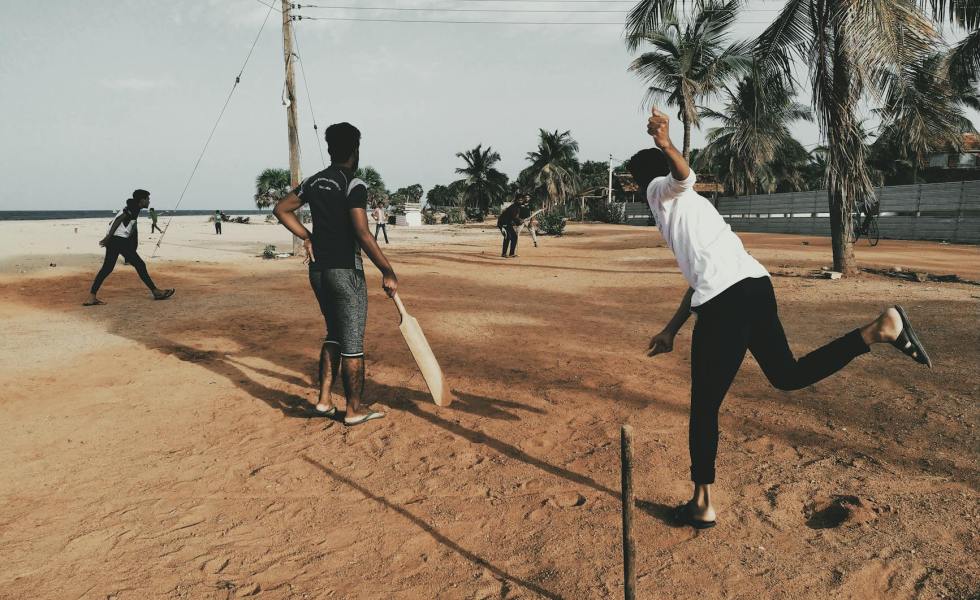
It is said we Sri Lankans are hardwired to love cricket. I confess this is the case with me. My love of cricket is the same as my race, gender and sexuality. I’m stuck with it. Cricketers flourished in the families of both my parents. My mother’s brothers played commendable cricket, but they were all outshone by my father who represented All-Ceylon, as the then-national team was called, just before and after World War 2.
Plagued throughout my childhood and young adulthood by timidity, social anxiety and a lack of confidence, I found in cricket a comforting escape. On the playing field I stood tall, thrilling in gladiatorial contests of bat against ball, rejoicing in my modest successes, despairing over my many failures, and always looking forward to the next match. There was nothing better than meeting the ball with the sweet spot of my bat, or taking a blinder at slips, or pitching my off-breaks just short of a good length and seeing the ball fizz past the batsman’s defences to upset the precious woodwork behind him. Although I never aspired to great heights, I never feared a cricket ball, however fast it was hurled or hit at me. I wore by bruises like badges of honour.
The right spirit was always an integral component. No matter how fierce the battle, fairness, integrity, decency and respect were never compromised. A sound thrashing left a less bitter taste than victory tainted by even a hint of cheating or bad behaviour.
I had a crush on the Australian cricket team. Throughout my TV-absent childhood of the 1950s and 60s, I followed Australia’s fortunes by grabbing snatches of cricket commentary between the crackles and hisses of short-wave radio, and scouring newspapers for the latest cricket scores. I cut out cricket photographs and articles from sports magazines and lovingly mounted them in scrapbooks.
On my tenth birthday, a new cricket bat materialised from behind my father’s back and my heart leapt with joy, not because I fancied myself as a batsman. The bat was autographed by Norman O’Neill, a dashing Australian superstar, the next Bradman according to some, and the love of my life. A few months later, the ship taking the Australian cricket team to England for an Ashes series docked in Colombo for a day or two. From the back row of the Colombo Oval pavilion, standing on my seat, I watched the Aussies under Richie Benaud take on All-Ceylon. It turned out O’Neill was the pin-up boy of a large vocal contingent of young women who yelled out to him whenever he ventured within earshot. I was outraged. He’s mine, I fumed. I couldn’t wait to return to the quietness of my bedroom, where I would have him all to myself.
In November 1974 I migrated to Australia. Many of the early days are blurred or no more in my memory, but Boxing Day 1974 stands out like a beacon. The Melbourne Cricket Ground rose before me like a mighty coliseum. Hordes of cricket fans gathered outside, many clad in shorts, tee shirts, thongs and war paint, which I learnt later was zinc cream, and bearing large metal boxes. As the day unfolded, nothing I had ever experienced in my humble island life prepared me for the onslaught of untrammelled, boisterous, alcohol-fuelled merriment. Approaching stumps, empty beer cans occupied every space not taken up by a human being. One portly gentleman unbuttoned his fly and urinated where he stood.
But the spectator circus was a mere sideshow. Doug Walters fielding in slips flung himself sideways to take a miraculous one-handed catch. Dennis Lillee and Jeff Thomson, bowling at lightning speeds, cut a swathe through Mike Denness’s hapless English batsmen. This cricket was a blood sport, played in deadly earnest, at a level of skill, agility, speed and strength unfamiliar to me.
In my sweet, innocent youth, I was unaware of the implications of my association of white skin with natural superiority over darker-hued people like me. After all, Sri Lankans had for centuries existed under the dominion of the Portuguese, Dutch and British. Cocooned among like-minded souls, I never realised that my enthusiastic Anglophilia was underpinned by inferiority. Then, on a mid-winter Saturday, an elderly white man, trembling in anger, ordered me to bugger off back to where I came from when I politely pointed out that he had jumped the queue in the Myer food hall. My colonial baggage opened like Pandora’s box. After weeks of seething and stewing, it dawned on me that I would never prosper in my adopted country unless I developed pride in my brown skin. My heroes of old were of no use here. I needed help from brown-skinned champions. Naturally, I looked to cricket to provide them. I considered the West Indian cricket team that toured Australia in 1975-76 but found it impossible to plunge into wholehearted affection for a team whose past champions, like Frank Worrell, Garfield Sobers, Rohan Kanhai and Wesley Hall, were cricketing gods I worshipped from afar. I craved a different set of heroes. My father entered the picture. I hadn’t been around during his cricketing heyday and carried a pulse of regret for that absence. The penny dropped. My heroes needed to be mortals familiar to me, with whom I could identify.
In 1981, the cricket team of the land of my birth was granted full test match status. These men, some of whom I knew personally, would be challenging the Aussies on their own turf. I latched onto them with the same parochial possessiveness with which my Aussie mates loved their sporting heroes. They vaulted into my heart and love gushed out. Whenever the Sri Lankan national team toured Australia from their first summer in 1982-83, my life became an emotional rollercoaster. I exulted in their successes and despaired at their failures. I was outraged when they were ill-treated by their opponents or umpires or the media or anyone. When Muttiah Muralitharan was persecuted because of a suspect bowling action, arguments in my generally non-confrontational life experienced a sharp spike. I spoiled for a verbal stoush with anyone who expressed the view that Murali was a chucker. Sri Lanka did not explode on the world stage. It took a few years before they commanded respect, when they became a force to be reckoned with. When Arjuna Ranatunga, ably supported by Aravinda De Silva, Sanath Jayasuriya, Romesh Kaluwitharana and others, held aloft the 1996 World Cup I found my multicultural niche as a proud Sri Lankan Australian. A few years later, my eyes moistened with pride each time Kumar Sangakkara and Mahela Jayawardena were lauded as ornaments of the game, not only for their exquisite skill but also for their exemplary on-field behaviour.
I played many seasons of competitive cricket and became thoroughly accustomed to the Australian way. On the field and in the clubhouse everyone was fair game for a ribbing, a sign of acceptance even when my very dark-skinned brother-in-law was called ‘Snowy’ by his teammates. I never felt I was disliked or disrespected because of my ethnicity. We all laughed easily, we all loved to play cricket and we all loved a drink afterwards. My Aussie teammates taught me that a heart of gold can co-exist with a little aggression combined with a lot of irreverence. I came to understand that irreverence is the essential ingredient of Australia’s egalitarian society. My skin thickened and I relaxed my strict standards of on-field behaviour.
But I never warmed to the Australian national team, privileged wearers of the iconic baggy green cap. The rose-hued spectacles I brought to Australia began its slide down my face at the MCG on that Boxing Day in 1974. An unpleasant reality about the Australian cricket team manifested in full glare. Instead of the heroes of my childhood, I saw a bunch of thuggish brats who regarded winning as an entitlement. They bullied opponents with humourless abuse, threats and taunts, and whinged when some dared to retaliate. Sooner or later they were bound to overreach.
In South Africa in March 2018, the mighty Australian cricket team unravelled hideously, caught cheating from more than one camera angle. The ringleaders of ‘sandpapergate’ were banished to their waterfront mansions and swanky apartments, where they spent many months licking their wounds and hopefully reflecting on their behaviour. When they returned to play cricket again the absence of swagger and snarl was refreshingly noticeable.
For a while Covid-19 prevented everyone from seeing if the lessons had sunk in. But I am pleased to report that the current Australian team is one I cheerfully support. This, in no small measure, is due to the current captain, Patrick Cummins, an uncompromising, fierce competitor and eminently decent human being.
A ten-year-old cricket addict in Sri Lanka today will be no less joyful than I was all those years ago at receiving a cricket bat for a birthday present. But their bat will have been autographed by Aravinda De Silva, Sanath Jayasuriya, Kumar Sangakkara, Mahela Jayawardena or another of Sri Lanka’s pantheon of cricket stars. Lucky boy. Or girl.


 Gerry Roberts